
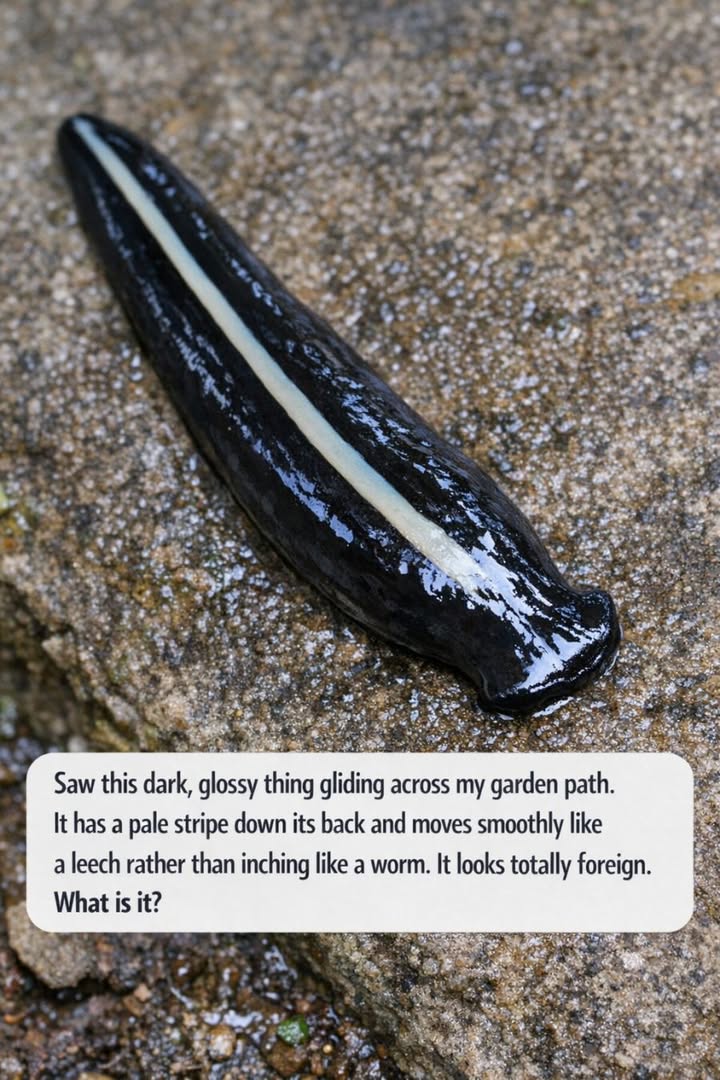
Gardening enthusiasts often encounter a diverse array of creatures amongst their plants, from beneficial insects to various pests. However, every so often, an unfamiliar presence can cause a stir, particularly when it glides smoothly across the garden path like something out of a science fiction movie. Such was the experience when a dark, glossy creature with a distinctive pale stripe appeared, prompting curiosity and concern.
At first glance, this creature may seem otherworldly, with its sleek, shiny appearance and unusual movement. It doesn’t inch along like a common earthworm, nor does it scuttle like an insect. Instead, it glides with an eerie grace, leading to questions about its origins and potential impact on the garden ecosystem. This article aims to shed light on this mysterious visitor and provide guidance on what actions, if any, should be taken.
1. Meet the Blue Garden Flatworm: The ‘Alien’ in Your Flowerbeds
The creature in question is likely the blue garden flatworm, scientifically known as Caenoplana coerulea. This terrestrial flatworm has been labeled as an invasive species in many parts of the world due to its non-native origins and its potential impact on local ecosystems. Measuring approximately 5 to 10 centimeters in length, the blue garden flatworm is renowned for its striking appearance.
Originally hailing from Australia and New Zealand, this flatworm has made its way to many other regions, often hitching a ride on plants and soil transported for horticultural purposes. Its presence in gardens can be both fascinating and disconcerting, as it is known to disrupt local soil ecosystems.
2. Key Visual Clues: Dark, Glossy Body and Pale Racing Stripe
The blue garden flatworm can be easily identified by its distinctive physical characteristics. It has a dark, glossy body that can range from blue to black, giving it a sleek, metallic sheen in the right light. The most notable feature, however, is the pale stripe that runs down the center of its back, reminiscent of a racing stripe.
This stripe can vary in color from pale yellow to cream, and it stands out starkly against the flatworm’s darker body. These visual markers, combined with its smooth, gliding movement, make it relatively straightforward to identify when compared to other garden inhabitants.
3. How It Moves: Why It Glides Like a Leech, Not Like a Worm
Unlike earthworms, which move by contracting and expanding their body segments in a characteristic inching motion, the blue garden flatworm moves via ciliary gliding. This involves the use of tiny hair-like structures called cilia on their underside, which beat in a coordinated fashion to propel the flatworm forward over a layer of mucus.
This method of locomotion is similar to that of a leech, allowing the flatworm to glide smoothly over surfaces. This efficiency in movement is one reason why they can so easily traverse garden paths and plant beds.
4. Where It Came From: An Invasive Traveler in Home Gardens
The blue garden flatworm is native to Australia and New Zealand but has been inadvertently introduced to several other countries, including parts of Europe, North America, and Asia. Its spread is largely attributed to the global trade in plants and soil, as flatworms can easily be transported in pots and soil without detection.
Once established in a new location, these flatworms can be difficult to remove, as they reproduce quickly and have few natural predators outside their native range. This means that gardeners in affected areas must be vigilant to prevent their spread and mitigate their impact.
5. What It Eats: A Silent Predator of Earthworms and Soil Life
The diet of the blue garden flatworm primarily consists of small soil invertebrates, with a particular preference for earthworms. This predation can have a significant impact on garden health, as earthworms play a crucial role in maintaining soil structure and fertility.
By consuming earthworms, the blue garden flatworm can disrupt the natural balance of the garden ecosystem, potentially leading to poorer soil health and reduced plant growth. This makes it essential for gardeners to monitor and manage these flatworms if they become established.
