
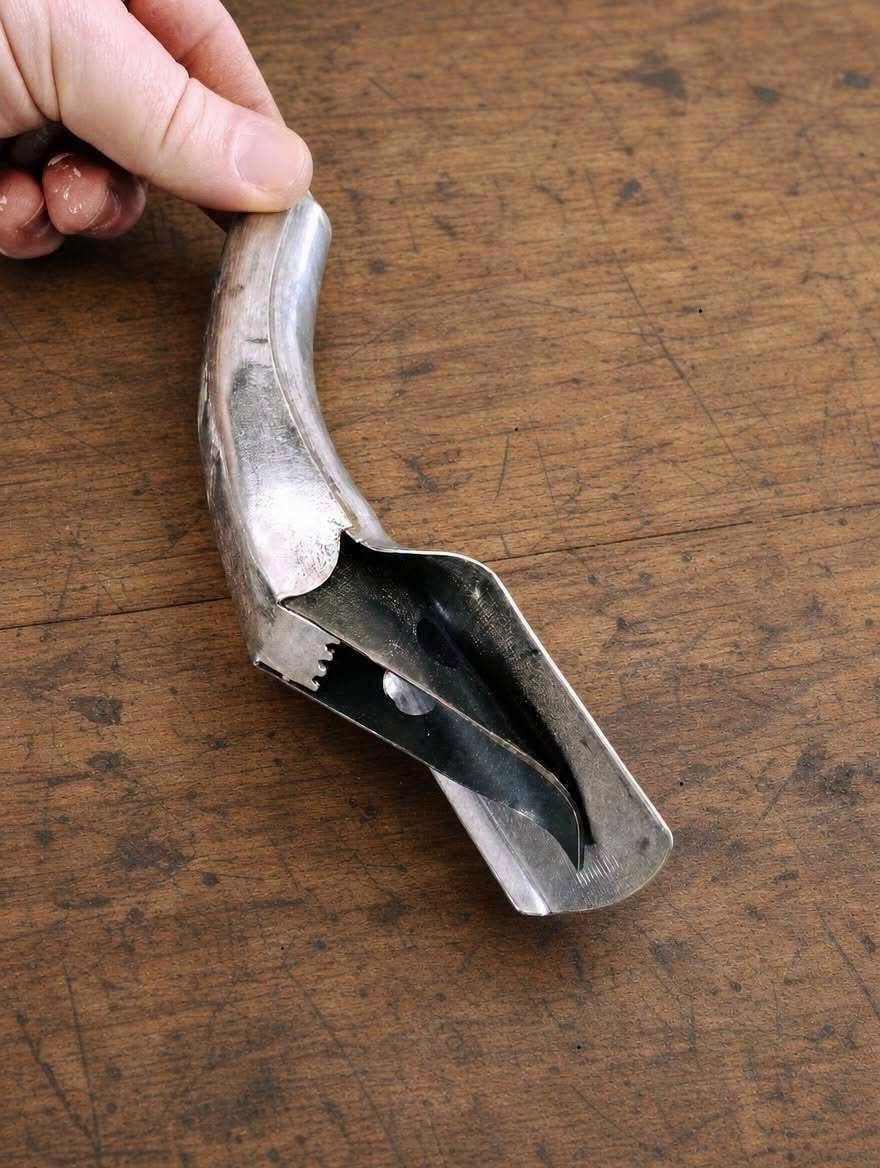
My Father Never Explained What This Strange Tool Was For He Just Smiled
Opening those cans required more than removing a lid. The tool pierced the metal and created a controlled channel or spout so oil could be poured into an engine or machine without spilling everywhere. Its shape combined the opening and pouring functions, which explains why it looked unfamiliar when separated from the can it was designed to fit.
In its own era, the opener would not have seemed rare. It belonged in garages, service stations, workshops, farms, and household tool collections. Mechanics and drivers handled containers that needed a sturdy implement capable of puncturing thin metal repeatedly.
Packaging technology eventually made the opener unnecessary. Oil increasingly arrived in containers that could be opened and poured directly, and disposable funnels or redesigned spouts replaced the old routine. The tool stopped appearing in active use and began migrating into drawers, sheds, inherited boxes, and antique displays.
That transition explains why one generation can identify an object instantly while the next invents elaborate theories. Recognition depends on experience, not intelligence. A person who has never seen a metal oil can being opened lacks the visual memory that made the mechanic’s answer obvious.
The father’s smile may have reflected that generational gap. He knew the object as something ordinary, while his son treated it as a mysterious machine. By preserving it without an explanation, he unintentionally allowed a routine piece of equipment to become a small puzzle and a connection to an earlier working life.
Identification can be supported by examining the tool’s construction and wear. Puncturing edges, channels that direct liquid, handles positioned for leverage, and residue associated with oil all point toward its purpose. Comparing it with old advertisements, catalogs, or documented examples can confirm the match.
Cleaning an antique should be approached carefully. Heavy polishing may remove markings, patina, or residue that helps establish age and use. Basic preservation and a written note about where the tool came from can be more valuable than making it look new.
The vintage oil can opener shows how quickly technology changes the meaning of objects. A device once understood by every service-station worker became nearly indecipherable within a few decades. Its discovery is not only an answer to a mechanical riddle. It preserves a story about packaging, maintenance, family memory, and the ordinary tools progress leaves behind.
Objects like this can also encourage conversations between generations. A younger person may search catalogs or collector groups, while an older relative supplies the sound, motion, and setting of actual use. Together, those perspectives reconstruct more than a name. They explain how the tool fit into work.
Once identified, the object no longer looks needlessly complex. Each edge, hinge, and channel has a reason. The transformation from mystery to obvious solution is what makes inherited tools so engaging. They reveal that ordinary knowledge can disappear quickly and return through one person’s memory.
