
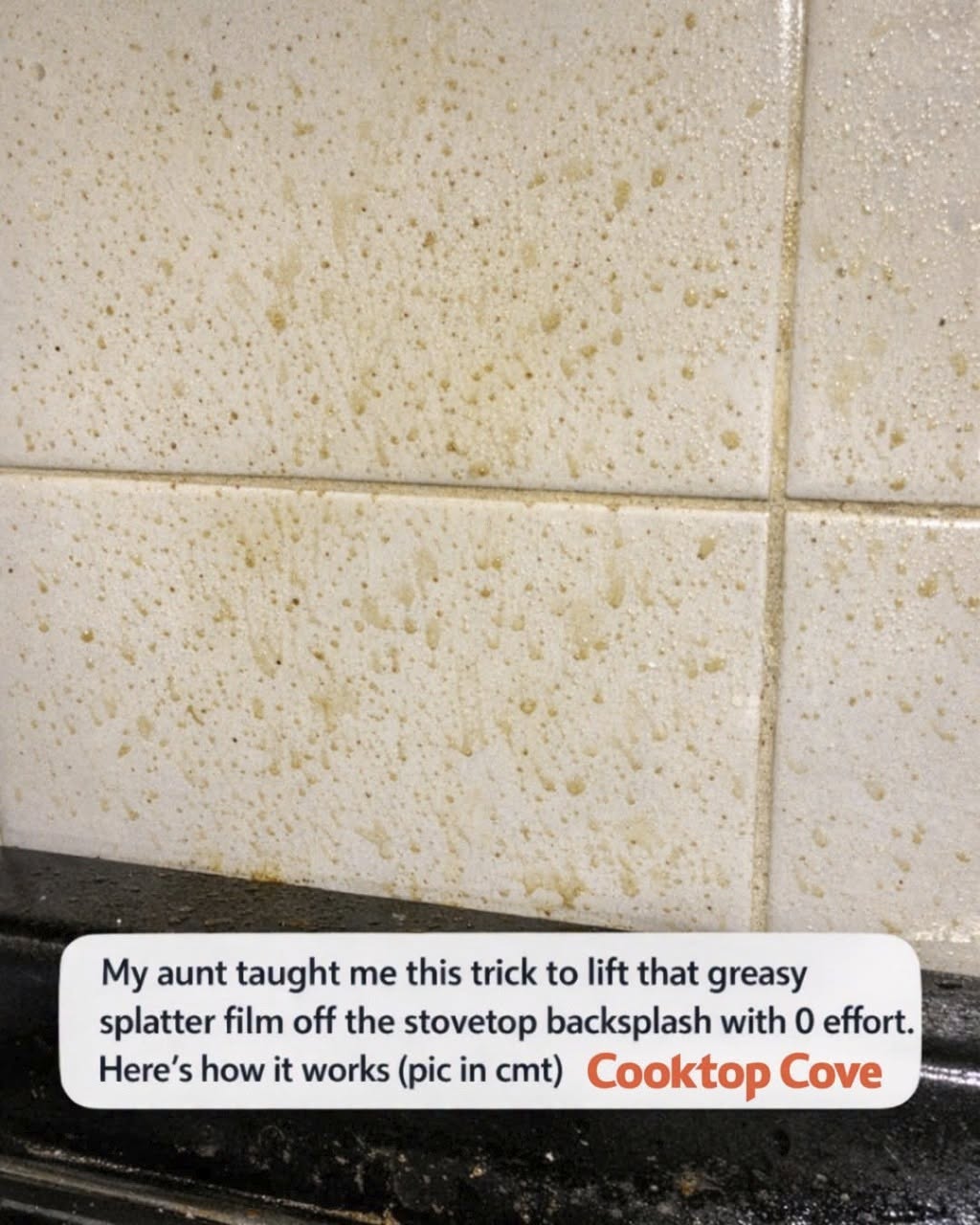
The first time my aunt showed me how to deal with that dull, sticky film that builds up on a stovetop backsplash, I genuinely thought she was winding me up. I had been scrubbing with a sponge, a spray degreaser, and far more irritation than the job deserved, yet the wall behind the burners still felt tacky when I ran my fingers across it. She walked in, took one look, and said, “You’re making it too hard.” Ten minutes later, the grease was soft, lifting cleanly, and I was wondering why nobody had taught me this years earlier.
The trick is simple: instead of attacking grease with force, you loosen it with heat, moisture, and contact time so it practically wipes away on its own. That’s the whole secret. In this article, I’ll walk you through exactly what I use, how to do it step by step, which surfaces it works best on, what to avoid, and how to keep that splatter film from building back up so quickly.
1. What that greasy film actually is
The haze on a backsplash is usually not just “grease” in the simple sense. It’s a mix of airborne cooking oil, steam, fine food particles, and dust. When you fry bacon, sear chicken, or simmer a tomato sauce without a splatter screen, microscopic droplets land on the wall or tile behind the stove. Over a few days, those droplets oxidize, collect dust, and turn into that yellowish or gray sticky film that seems bonded to the surface.
This is why dry wiping rarely works. You’re not dealing with loose dirt; you’re dealing with a thin layer of softened fat and grime. Once you understand that, the solution makes more sense: soften first, wipe second.
2. My aunt’s “0 effort” trick in one sentence
Her trick was to press a very warm, damp towel against the backsplash for 3 to 5 minutes, then wipe with a mild grease-cutting solution while the residue is still softened. No hard scrubbing, no abrasive pads, and no spending 20 minutes attacking one greasy patch.
The “0 effort” part is really about letting time and moisture do the heavy lifting. You are not dissolving years of neglect in one swipe, but you are making an annoying job dramatically easier.
3. What you need before you start
I keep this setup very basic: 2 microfiber cloths, 1 bowl or sink of hot water, 1 drop to 1 teaspoon of dish soap depending on the amount of buildup, and a dry towel for finishing. If the grease is heavy, I also use a spray bottle with a 1:1 mix of warm water and white vinegar, though I skip vinegar on natural stone or any surface the manufacturer warns against.
For most backsplashes, hot tap water is enough, ideally around the hottest comfortable household temperature. You do not need boiling water. A cloth that is hot and damp, not dripping, is safer and easier to control.
4. Start safely by cooling the cooking area
If you’ve just cooked, turn everything off and let the stovetop cool until it is warm at most, not hot. Gas grates, electric coils, and induction surfaces can all retain heat. I usually wait 15 to 30 minutes after cooking before cleaning the backsplash.
You also want to remove anything sitting near the wall: oil bottles, salt cellars, utensil crocks, and spice jars. That gives you full access and keeps grease from smearing onto other items as you wipe.
5. The warm towel step that does most of the work
Soak a microfiber cloth or thin dish towel in hot water, then wring it out thoroughly so it is damp but not dripping. Press it directly onto the greasy backsplash area. If you’re working over tile, smooth it over the grout lines as well. Leave it there for 3 minutes for light film, 5 minutes for medium buildup, and up to 8 minutes for stubborn splatter near the center burner.
This step matters because warmth softens oil, and moisture helps loosen the bond between the grease film and the surface. On painted walls, I use a well-wrung cloth and shorter contact time, usually no more than 2 to 3 minutes, to avoid over-wetting the paint.
6. Use dish soap where it counts
After the warm compress, add a small drop of dish soap to a fresh damp cloth. If I’m cleaning a 24-inch to 30-inch-wide backsplash section, about 1/4 teaspoon is usually enough. Wipe in slow, overlapping strokes from top to bottom so loosened grease moves downward instead of spreading sideways.
Dish soap works well because it is designed to break up fats. You do not need a thick lather. In fact, using too much soap can leave a residue that attracts more dust later. A little goes a long way.
7. Why microfiber beats scrub sponges here
⏬Continued ⏬on the ⏬next ⏬page
