Orchid on the Run? Why Roots Escape Their Pots and How to Help
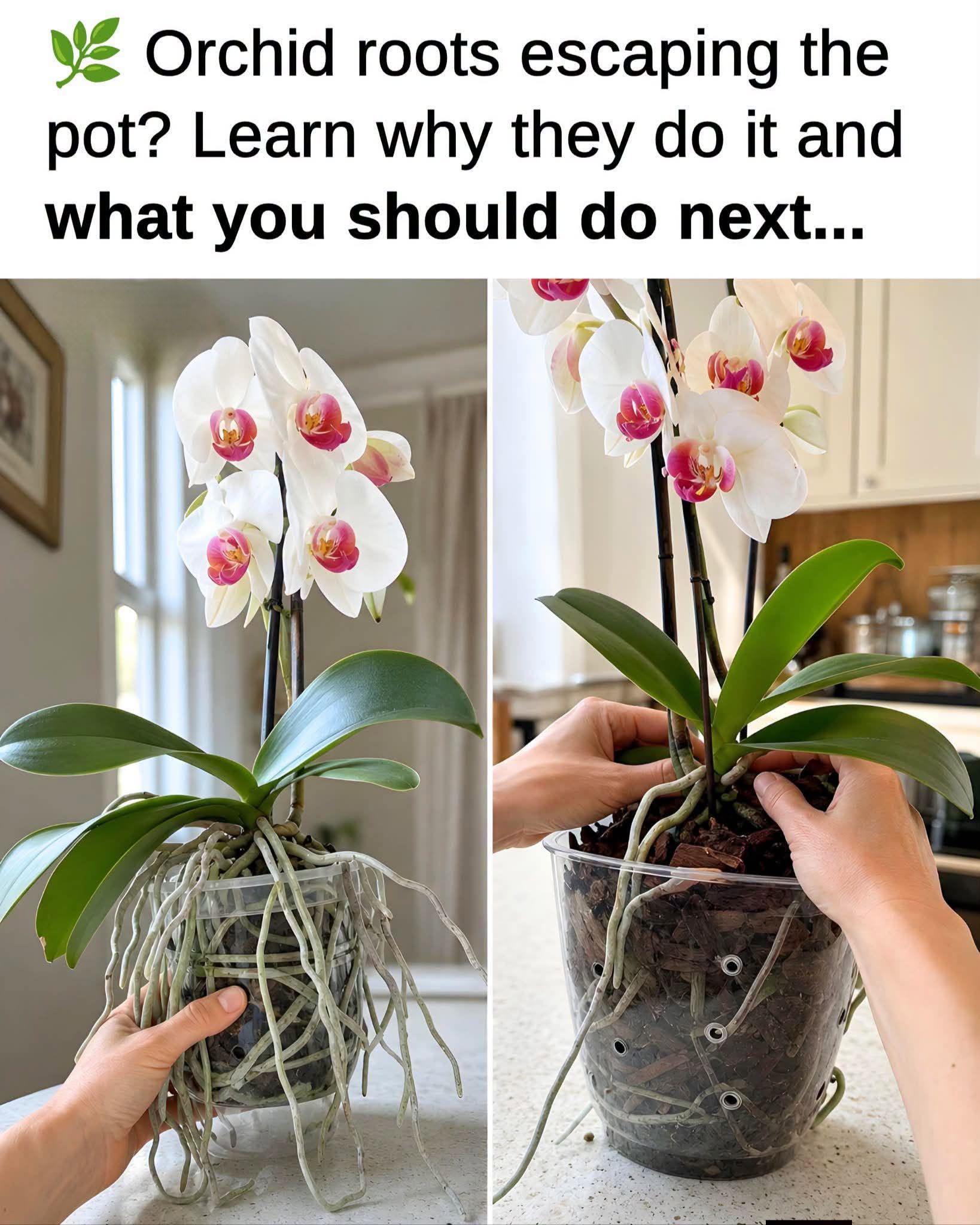
One day, your orchid looks neatly settled in its pot. A few weeks later, thick roots are curling over the rim, reaching into the air, or trailing across the windowsill.
Is it outgrowing its home? Does it need more water? Should you trim those wandering roots?
For a moth orchid, or Phalaenopsis, roots growing outside the pot are usually normal. These aerial roots are part of the plant’s natural growth habit. Leave healthy roots intact, and check the potting mix and roots inside the container before deciding to repot. The Royal Horticultural Society advises against cutting off or burying healthy exposed moth-orchid roots.
This guide focuses on Phalaenopsis, the common indoor orchid with broad leaves and arching flower stems. Other orchids can have different watering and potting requirements.
Why Do Orchid Roots Grow Outside the Pot?
Many familiar orchids are epiphytes: in nature, they grow attached to trees rather than rooted in ordinary garden soil.
Their roots help anchor them to branches and absorb water and dissolved nutrients from their surroundings. A flowerpot gives an indoor orchid support, but it does not change that natural growth habit.
Orchid roots also have a specialized outer covering called velamen. This spongy layer helps capture water, while the root system needs access to air as well as moisture.
A root growing over the rim is therefore not automatically escaping bad conditions. It may simply be growing into available space.
The useful question is whether the entire root system is healthy.
Normal Aerial Roots or a Sign of Trouble?
Look at three things together: the exposed roots, the roots inside the pot, and the growing medium.
Normal growth is more likely when:
- Exposed roots feel firm rather than mushy.
- Leaves remain reasonably firm.
- The pot drains freely.
- The orchid is producing new growth.
- The growing medium still has an open structure.
A closer inspection is worthwhile when:
- Roots inside the pot are deteriorating.
- Bark has crumbled into fine particles.
- The medium stays wet much longer than it previously did.
- The plant has grown substantially above or beyond its container.
- Leaves wrinkle despite the potting mix remaining wet.
The American Orchid Society identifies deteriorating medium and a plant genuinely outgrowing its container as the main reasons to repot. Aerial roots alone do not establish either condition.
How to Recognize Healthy Orchid Roots
Healthy moth-orchid roots are generally firm and substantial. Exposed roots often look silvery-white when dry and greener after wetting.
Color is useful, but it should not be your only test. A root stained by bark is not necessarily dead.
More concerning signs include roots that are mushy, hollow, collapsing, or severely shriveled. Check gently rather than repeatedly squeezing or bending them.
When repotting, remove clearly dead or decaying roots while preserving functioning ones.
If you cannot confidently tell whether a root is alive, avoid cutting it merely because its color differs from the others.
Should You Cut Off Orchid Roots Outside the Pot?
Do not trim healthy aerial roots to make the orchid look tidier.
These roots are functioning parts of the plant. Their position outside the container does not make them unnecessary.
Instead, give the orchid enough room on its shelf or windowsill that the roots are not repeatedly knocked, trapped behind a pot, or caught when you move it.
Root trimming is appropriate for clearly dead or rotting tissue during necessary maintenance—not as routine cosmetic pruning.
Do Escaping Roots Mean the Orchid Needs a Bigger Pot?
Sometimes, but not always.
An orchid may need fresh growing medium in the same pot, rather than a larger container. If damaged roots are removed, the remaining root system may even occupy less space.
Choose the container according to the healthy root mass. Do not size it according to the height of the flower stem or the length of roots that will remain exposed.
The American Orchid Society recommends matching the pot to the root system rather than the foliage.
Buying an oversized pot to hide every aerial root can create a new problem: a large volume of unused medium that dries slowly.
When Should You Repot an Orchid?
Plan routine repotting when the orchid is starting active root growth. If the plant is healthy and flowering, waiting until the flowers finish usually makes the process less disruptive.
However, do not postpone necessary attention to a deteriorating root system simply to preserve the display.
The American Orchid Society notes that repotting during bloom is possible when needed, although flowers may finish prematurely. It also identifies the beginning of new root growth as a favorable time.
Inspect the medium periodically rather than relying entirely on a calendar. Its useful life varies with the material, watering, and growing conditions.
How to Repot an Orchid With Aerial Roots
Prepare a clean draining pot, fresh orchid medium, and clean cutting tools before starting.
1. Ease the plant out gently.
Support the plant near its base and work carefully around attached roots.
Do not lift it by the flower spike or pull hard on roots caught in drainage holes. If a disposable plastic pot must be cut away to release them safely, protecting the roots matters more than preserving the pot.
2. Remove deteriorated growing medium.
Gently work old material out from between the roots. Take your time around fragile growing tips.
This allows you to see the condition of the root system rather than simply surrounding old, compacted material with fresh bark.
3. Remove clearly dead roots.
Use clean tools to cut away decayed tissue. Preserve firm roots and avoid unnecessary shortening.
4. Choose a suitable pot and medium.
Use a pot with drainage holes and a growing medium intended for your orchid type. For a typical moth orchid, an airy orchid bark mix is a practical starting point.
Different media retain different amounts of water. Sphagnum moss is not automatically harmful, but it requires watering suited to its moisture retention. The American Orchid Society emphasizes matching the medium to the growing environment and the grower’s watering habits.
5. Settle the plant without forcing the roots.
Keep the plant at an appropriate depth, with the crown above the medium. Arrange roots gently and fill around them without crushing the growing tips.
Leave established aerial roots outside rather than forcing them into tight bends.
Support a loose or leaning plant while new roots establish. Stability helps protect delicate new growth.
