
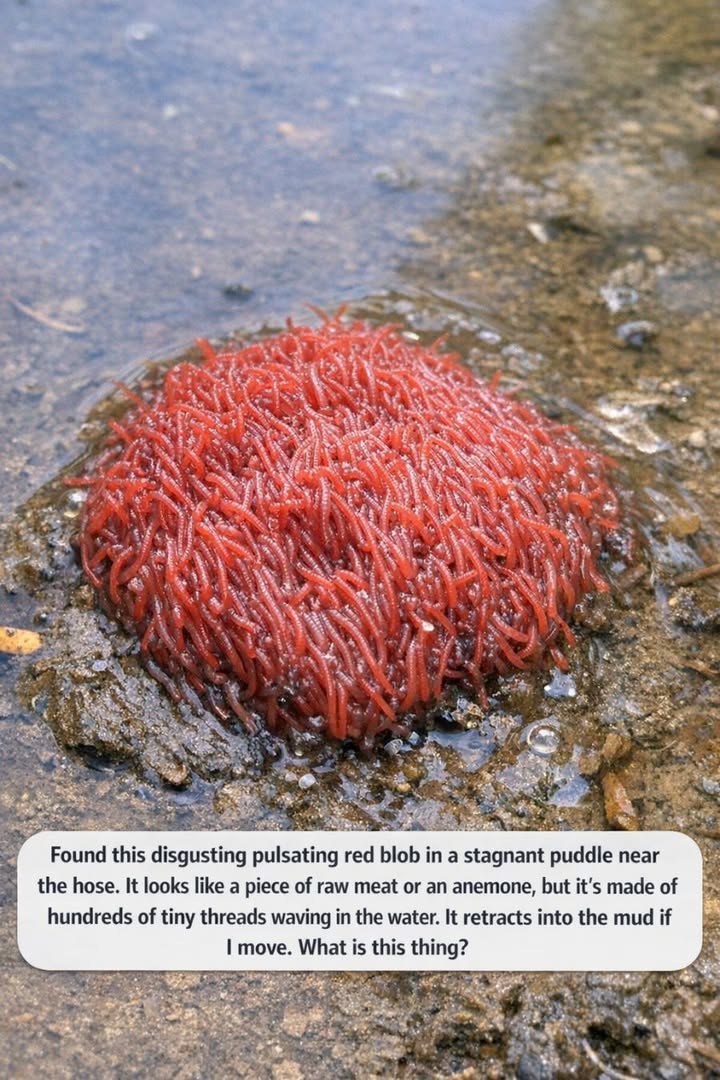
If you’ve stumbled upon a bizarre, pulsating red blob in your backyard, you might have initially recoiled in disgust or curiosity. Resembling a piece of raw meat or even a strange underwater anemone, this peculiar sight can be both fascinating and unsettling. Such discoveries are not uncommon, especially in areas where water collects and becomes stagnant.
These blobs, often found in puddles or near garden hoses, are not just random occurrences. They are part of a larger ecological system that thrives in specific environmental conditions. As you delve deeper into understanding what these blobs are, you’ll uncover a world of microscopic wonders and complex biological interactions that explain their presence and behavior.
1. The Shocking Sight: A Pulsating Red Blob in Your Backyard
Seeing a pulsating red blob in your backyard can be quite alarming. These blobs can measure anywhere from a few centimeters to a foot in diameter, depending on the size of the colony. Their vibrant red color and rhythmic pulsations can make them look alive, which in a way, they are.
These blobs are typically found in stagnant water, such as puddles or areas with poor drainage. They may appear to be a single entity, but upon closer inspection, you will find that they are composed of numerous tiny threads waving in the water. This sight can be both mesmerizing and disturbing, as the blobs seem to respond to movement and stimuli in their environment.
2. Why It Looks Like Raw Meat or a Strange Anemone
The appearance of these blobs can be deceiving. They often look like a piece of raw meat due to their fleshy red color and semi-translucent nature. The way the mass undulates in the water can also give it the appearance of an anemone, with its tentacle-like threads swaying in the current.
These visual similarities are due to the structure and behavior of the individual organisms that make up the blob. The reddish hue is a result of hemoglobin present in the tiny worms, which helps them survive in low-oxygen environments. The movement is a collective effort of thousands of worms interacting with their surroundings, giving an illusion of a single, cohesive creature.
3. The Real Culprit: Meet the Tubifex Worm Colony
The red blob you’ve encountered is actually a colony of tubifex worms, also known as sludge worms. These tiny segmented worms, belonging to the family Tubificidae, are often found in nutrient-rich, muddy environments. Tubifex worms can grow up to 20 millimeters in length and are characterized by their reddish color, which comes from their blood rich in hemoglobin.
The worms live in dense colonies, forming large, gelatinous masses that can often be seen pulsating as they contract and expand to circulate water and nutrients. These colonies can thrive in conditions that would be inhospitable to many other organisms, such as low-oxygen, polluted environments.
4. How Hundreds of Tiny Worms Act Like One Creepy Organism
A tubifex worm colony behaves like a single organism due to the coordinated movement of its individual members. Each worm is capable of independent motion, but together they create a synchronized pulsation that helps with their collective survival. This movement facilitates the circulation of water and nutrients throughout the colony, ensuring that each worm has access to the resources it needs.
The worms communicate with each other through chemical signals and physical contact, allowing them to respond quickly to changes in their environment. This coordination allows the colony to retract into the mud when disturbed, a defensive mechanism that protects them from potential threats.
5. Why It Pulsates and Retracts When You Move
The pulsating motion of a tubifex worm colony is primarily a result of the worms’ collective effort to facilitate water flow and nutrient exchange. This rhythmic contraction and expansion are essential for their survival in stagnant water environments where oxygen levels are low.
When the colony senses movement or vibrations, it will often retract into the mud as a protective response. This behavior is a survival strategy, as it helps the worms avoid predation or other disturbances. The retraction is a rapid contraction of the worms, pulling the entire mass into the sediment where it can remain hidden from view.
