
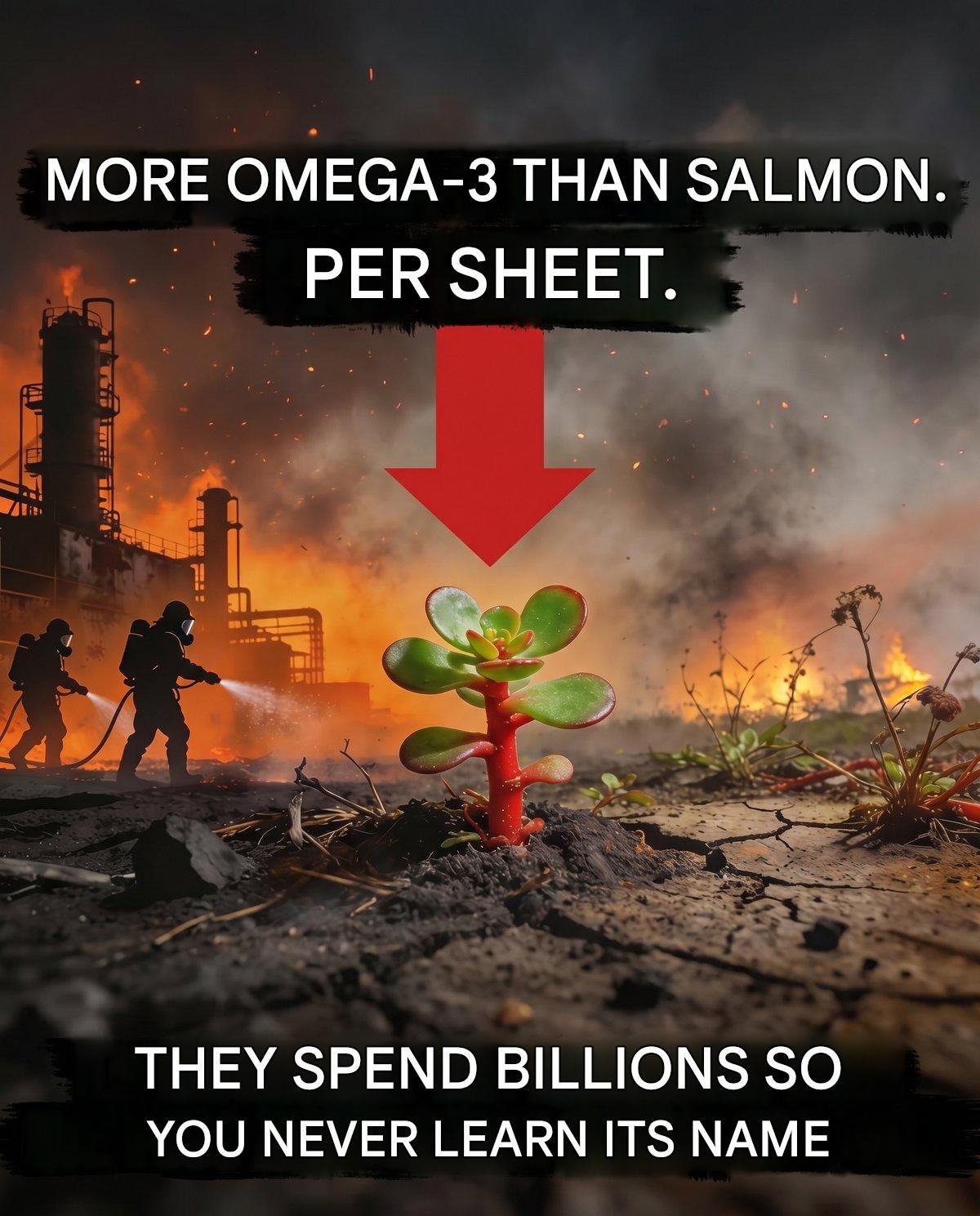
Chances are, a small plant with red stems is currently creeping through the cracks in your driveway or in a corner of your garden. This plant, which most of us are so eager to pull out, actually contains more omega-3 fatty acids than salmon, not per kilo, but per leaf. It has nourished humanity for over 4,000 years, survived the fall of the greatest empires, and possesses adaptive capacities that science, until recently, considered biologically impossible.
Yet the agrochemical industry spends billions to ensure you continue to think of it as just another weed to be eradicated. This is the fascinating story of purslane ( Portulaca oleracea ), a forgotten superfood.
A staple food for millennia
The history of purslane dates back to antiquity. As early as 1000 BC, seeds were being stored in clay containers in northern Greece. By the 7th century BC, they had been found in the ruins of Samos, a major sanctuary of ancient Greece. In the 4th century BC, the philosopher and botanist Theophrastus even recommended that farmers sow it in April, alongside their main crops.
Purslane was never a weed for our ancestors; it was a true source of sustenance. The Roman Empire cultivated it on three continents, and medieval Europeans consumed it daily. Records from 1288 show that it was listed as a staple food in the city of Milan.
On the other side of the Atlantic, long before the arrival of European settlers in 1492, Native Americans were already cultivating it. Archaeologists have found seeds dating back to 800 BC in Kentucky and to 1350 in Ontario. Two civilizations, separated by an ocean, had both understood the essential nature of this plant.
The secret of the Cretan paradox
In 1960, physiologist Ancel Keys launched the famous Seven Countries Study to understand why certain populations were immune to heart disease. The results overturned the prevailing beliefs of the time: farmers on the island of Crete, whose diet was extremely high in fat (more than 35% of their calories), had the lowest cardiovascular mortality rate ever recorded.
For twenty years, the scientific community attributed this miracle to olive oil. But in the 1980s, a new analysis of blood samples revealed another truth: Cretans had three times more omega-3 fatty acids than other studied populations, without eating astronomical quantities of fish. Their secret? They consumed purslane every day (in salads, stews, and stir-fries) and fed it to their chickens and goats. The entire island’s food system was based on this wild plant.
In 1992, Dr. Artemis Simopoulos analyzed the composition of purslane. The results astonished researchers:
- 300 to 400 mg of alpha-linolenic acid (ALA) per 100 g of fresh leaves (5 to 7 times more than spinach).
- The presence of EPA (eicosapentaenoic acid) , a marine omega-3 usually found in fish and algae, is an absolute rarity for a terrestrial plant.
- 7 times more vitamin E than spinach.
- 6 times more beta-carotene than carrots.
- Exceptional concentrations of melatonin, glutathione, potassium, magnesium and calcium.
A biological impossibility demonstrated by NASA and Yale
In 2022, Dr. Erica Edwards and her team at Yale University published results in the journal Science Advances that rewrote the laws of photosynthesis. They discovered how purslane manages to grow at an astonishing rate while surviving extreme droughts.
The majority of plants use only one type of photosynthesis:
- The C3 or C4 system (like corn): ideal for rapid growth, but requires a lot of water.
- The CAM system (like cacti): opens its pores at night to conserve water, but results in very slow growth.
Researchers have discovered that purslane uses both C4 and CAM systems simultaneously within the same cells . C4 activity ensures rapid growth during the day, while CAM activity guarantees survival at night. This is the biological equivalent of an engine running on both gasoline and electricity in the same combustion chamber. Thanks to this, purslane requires ten times less water than corn and thrives in incredibly saline soils.
The agrochemical industry war
If purslane is so exceptional, why is it considered a weed? Because it is impossible to control and monetize.
A single plant produces up to 200,000 seeds, which can remain viable in the soil for 40 years. Each stem fragment that touches the ground takes root to create a new plant. It is resistant to heat, drought, and even solarization (the technique of superheating the soil under a plastic sheet).
Faced with this resilience, the herbicide industry (a $40 billion global market) has declared war on purslane. Giants like Bayer and Syngenta sell products specifically formulated to eradicate it. Agricultural agencies publish eradication guides because purslane doesn’t fit the industrial model: it cannot be patented, its seeds cannot be made sterile, and farmers cannot be forced to buy it every year.
