
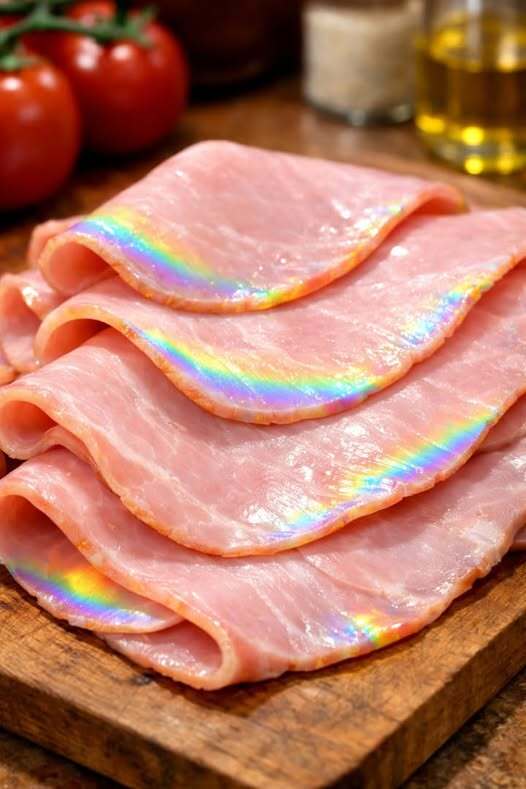
When ham is cut, the surface becomes smooth in places and jagged in others. Muscle fibers align from years of animal movement. These fibers reflect light at various angles. When the wavelengths overlap, they create a diffraction pattern. Thin slicing increases visibility because light enters and exits the surface more uniformly.
Moisture acts like a magnifying lens, intensifying the effect. Curing salts stabilize pigments inside the muscle, making them reflect more consistently. Add store lighting—which is often bright, white, and angled—and the colors become obvious.
That shimmering rainbow is the same physical phenomenon that makes gasoline rainbow on a puddle, though the source is different. It’s diffraction, not contamination.
Understanding that helps reduce fear—but doesn’t replace caution.
People often rely too heavily on appearance when judging food safety. Visual cues matter, but they’re not the only ones. That shiny sheen on your deli ham is one of the few cues that can be misleading. It looks unusual but is harmless, while dangerous changes—smell, slime, subtle discoloration—may appear less dramatic yet carry far more risk.
Never assume meat is safe because it “looks okay.” Always involve all your senses.
Touch reveals texture changes that eyes miss.
Smell reveals decay that touch and eyes miss.
Taste should never be the tool for testing meat safety.
When deli ham tastes “off,” it’s too late.
Let’s talk about storage in greater depth.
Deli ham is highly perishable once exposed to air. Oxygen accelerates fat oxidation, which changes flavor and texture. Moisture evaporates or collects on the surface, depending on humidity. Packaging must be tight enough to limit oxygen exposure. Plastic wrap helps but isn’t perfect. Air pockets inside loosely sealed bags create breeding grounds for bacteria.
The ideal storage method:
Keep meat in its original packaging if unopened.
After opening, wrap tightly in aluminum foil or butcher paper.
Place the wrapped meat inside an airtight container.
Store at the back of the refrigerator where temperatures stay consistent.
Never leave deli meat on the counter while prepping for long periods.
Write dates on packaging so you know exactly how long it has been open.
The “smell test” is helpful, but dates keep you honest.
People overestimate their ability to detect freshness by scent alone.
Any deli ham older than 5–7 days should be thrown out—rainbow sheen or not.
Here’s what often surprises people: sometimes fresh deli ham looks less vibrant and more dull than older ham. The rainbow can appear on ham that’s perfectly safe or ham that’s a day away from spoiling. This inconsistency fuels confusion. That’s why the rainbow itself cannot be the deciding factor. It is only one piece of a larger evaluative puzzle.
Some people worry about additives creating iridescence. While curing salts influence pigment, they do not produce unsafe conditions. In fact, nitrites inhibit bacterial growth, reducing risk. The colors are not chemical stains. They’re reflections.
Aging or rotting ham, on the other hand, may develop a slick shine that is not rainbow-like but glossy and wet. This shine is different. It lacks the spectral colors and instead reflects light in a uniform, almost oily way. This indicates bacteria producing compounds that alter surface texture.
If the shine is colorful and crisp—optical interference.
If the shine is wet and greasy—spoilage.
Learning to differentiate the two will prevent unnecessary waste and prevent illness.
There’s one more nuance worth understanding: deli meat sliced at a butcher counter tends to spoil faster than pre-packaged slices. This is because the slicer may introduce bacteria, and thicker cuts reduce surface aeration. Thin, tightly sliced ham lasts slightly longer because the surface area increases drying, which prevents bacterial overgrowth—but only to a point. No deli meat is designed for extended storage.
Listeria complicates this further. It’s one of the rare bacteria that thrive in cold environments. It can survive on cutting boards, slicers, refrigerator shelves, and even sealed packages if contamination occurs at the factory or deli counter. This is why high-risk individuals—pregnant women, older adults, immunocompromised people—are advised to heat deli meats until steaming before eating.
Heating eliminates Listeria risk. The rainbow does not influence this danger.
In the end, interpreting the rainbow on deli ham requires a blend of science and common-sense food safety. A shimmering sheen by itself is nothing to worry about. But a sheen surrounded by red flags becomes a warning you should never ignore.
Continued on next page:
