
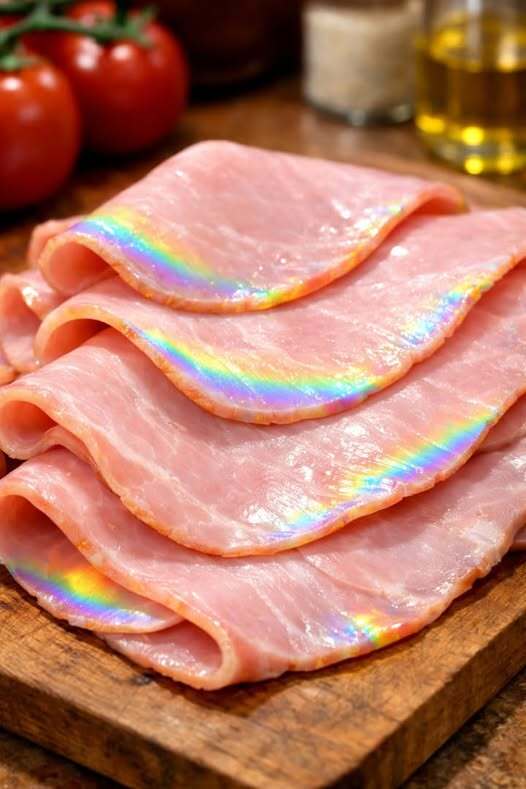
Next, texture. Ham should feel smooth and slightly moist. Not wet. Not sticky. Not slimy. When harmful bacteria multiply, they produce extracellular polysaccharides—substances that feel like thick, slippery mucus. Sliminess is one of the clearest indicators of spoilage in deli meats. If your fingertips sense anything unpleasant or unusual, the ham belongs in the trash.
Then there’s smell, the most reliable and immediate warning system. Good ham smells faintly salty, smoky, or meaty. Spoiled ham smells sour, sulfurous, tangy, or ammonia-like. These odors are caused by byproducts of bacterial metabolism. If the scent makes you recoil even slightly, do not eat the meat. Trust your instincts. Your nose evolved to detect danger.
Finally, time. Opened deli meat, even when stored properly, is fragile. Once exposed to oxygen, it begins to age rapidly. Harmful bacteria like Listeria monocytogenes thrive in cold environments, meaning the refrigerator slows spoilage but doesn’t stop it. The recommended window for safely eating opened deli meat is 3–5 days. Pre-packaged sliced ham may last slightly longer, but once opened, it follows the same rule. Past a week? You’re gambling.
The rainbow might distract you, but it does not extend the life of the meat. Slices can appear shiny and iridescent while silently growing harmful bacteria.
This is why trusting your senses—not the rainbow—is essential.
When deli ham sits too long in the fridge, tiny shifts occur before anything becomes visibly obvious. Bacteria multiply slowly at first, then rapidly. A faint sourness appears. Moisture increases. The edges soften. The meat becomes slightly tacky. These early signs can be subtle enough to ignore. But ignoring them risks food poisoning that ranges from uncomfortable to life-threatening.
Listeria, a bacteria often associated with deli meats, is particularly dangerous because it grows at refrigerator temperature. It doesn’t require warmth. It doesn’t need mishandling. It only needs time. Healthy adults may recover quickly from a Listeria infection, but pregnant individuals, the elderly, or those with weakened immune systems can face severe complications.
Salmonella and Staphylococcus aureus also lurk in improperly stored deli meat. Staph toxins resist heat. Even cooking the ham won’t save it once the bacteria have multiplied enough to release toxins.
This is why the rules around deli meat storage are strict.
Keep it in the coldest part of your fridge—usually the back, never the door shelves. Wrap it tightly, ideally in airtight packaging. Avoid letting it sit open or exposed. Rotate older meats toward the front so you remember to use them first.
But even with perfect storage, time remains the enemy.
The moment your senses detect anything unpleasant—smell, texture, color—your decision is made.
Yet here’s the twist that confuses many people: ham can smell and feel fine even when it’s unsafe. Some bacteria grow without producing noticeable sensory changes. But these scenarios are rare compared to the noticeable ones. When your senses do alert you, the danger is already high. When they don’t, the risk remains low as long as time guidelines were followed.
This is why understanding the rainbow sheen is helpful. It prevents people from discarding perfectly safe meat while also encouraging them to investigate deeper when something feels off.
A rainbow by itself? Normal.
A rainbow plus slime? Danger.
A rainbow plus sour odor? Trash immediately.
A rainbow plus fading color? Spoilage has begun.
A rainbow on meat opened 10 days ago? Too old to trust.
A rainbow on freshly sliced deli ham eaten promptly? Safe.
Optical illusions don’t make meat unsafe. Time and bacteria do.
Many people panic because the rainbow resembles oil slicks or chemical contamination. But the chemical reactions that cause spoilage look different. Spoiled meat doesn’t shimmer with clean, sharp color bands. It dulls. It clouds. It mottles. It darkens. Spoilage takes away vibrancy instead of enhancing it.
The rainbow is science. Spoilage is biology.
Knowing the difference empowers safer choices.
Let’s break down how light interacts with meat.
Continued on next page:
