
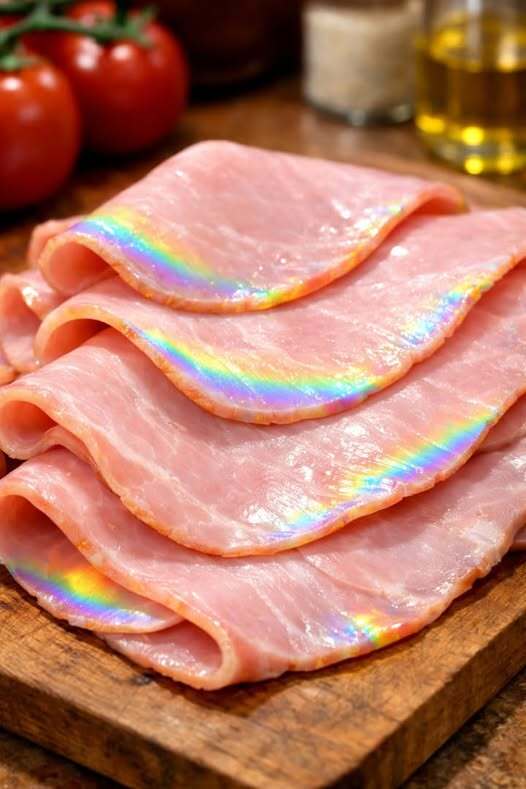
After pulling deli ham from the refrigerator, many people freeze for a moment at the sight of it: a shiny, almost metallic rainbow shimmer stretched across the slices. It looks unnatural, suspicious—wrong somehow. For some, it triggers instant panic: Is this spoiled? Is this bacteria? Is this dangerous? Others shrug and keep making their sandwich, assuming it’s nothing.
The truth sits somewhere between comfort and caution.
The rainbow isn’t always a warning sign.
But sometimes, it’s the final hint your senses will give you before a very unpleasant mistake.
Understanding the difference can protect your health.
That shimmering sheen you see can be pure science—light interacting with proteins. But it can also be the quiet signal of meat that’s no longer safe to eat. Your nose, your fingers, your eyes all become your first line of defense. One wrong bite, one ignored smell, and the consequences can be more severe than most people realize.
The real story behind rainbow ham isn’t just about color. It’s about physics, spoilage, bacteria, storage, and knowing exactly how to read the signs.
The colorful sheen on your ham is usually just optical interference—light hitting the surface of the meat in a very specific way. Ham is made of muscle fibers aligned in tight, parallel structures. When light strikes these fibers, it splits and refracts, much like light striking a soap bubble, a puddle with oil, or the surface of a CD. The layers of muscle reflect different wavelengths of light, producing a rainbow effect.
Curing salts amplify this effect. Sodium nitrite, a compound used to preserve color and prevent bacterial growth, stabilizes the pigment in ham. This pigment, combined with moisture inside the meat, makes rainbow refraction more visible. The thinner the slice, the more dramatic the shimmer. Razor-thin deli meat tends to bend, ripple, and catch light at many angles. This creates the visual illusion of shifting colors even when nothing is wrong.
That rainbow sheen, by itself, is normal.
It can appear on freshly sliced deli ham, turkey breast, roast beef, or corned beef. It doesn’t indicate spoilage. It doesn’t indicate chemical contamination. It doesn’t indicate danger.
But the rainbow only tells one story. Spoilage tells another.
The danger begins when the rainbow effect appears alongside actual warning signs—changes in color, texture, smell, or moisture. A harmless sheen doesn’t evolve into spoilage, but spoilage can mask itself behind that glow. People who rely solely on sight risk missing the signals that matter far more.
Start with color beyond the rainbow. Ham should be pinkish, slightly rosy, or lightly peach colored depending on the cut and cure. If it turns dull gray, brown, green, or black, something is wrong. These colors appear when pigments break down due to age, oxidation, or bacterial growth. While oxidation alone isn’t harmful, bacterial discoloration absolutely is.
Green or iridescent patches—different from the rainbow sheen—indicate compounds produced during bacterial growth. These patches aren’t light-based illusions. They’re chemical reactions caused by microbes metabolizing proteins. If you see those, the meat is unsafe.
Continued on next page:
