
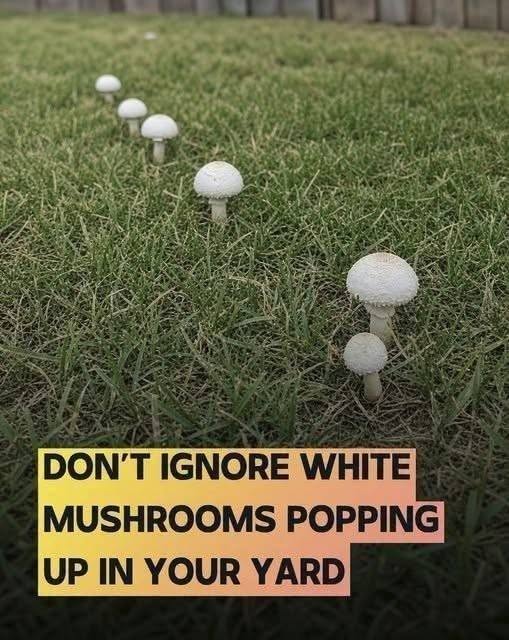
Have you ever walked outside in the morning and discovered little white mushrooms scattered across your lawn?
One day, the grass looks completely normal. The next, dozens of pale caps seem to have appeared out of nowhere.
For many homeowners, the first reaction is concern. Are the mushrooms damaging the lawn? Is something wrong with the soil? Should they be removed immediately? And perhaps most importantly, are they dangerous?
The surprising answer is that mushrooms appearing in your yard aren’t necessarily a bad thing.
In many cases, those small white caps are simply the visible portion of a much larger fungal network living beneath the soil. They can tell you something about moisture, organic matter, decomposition, soil conditions, and the hidden ecosystem underneath your grass.
Of course, not every mushroom is harmless, and you should never eat a wild mushroom simply because it appears in your yard. But instead of automatically treating mushrooms as weeds, it can be useful to understand what their appearance may be telling you.
Here are 15 possibilities.
1. Your Soil May Be Rich in Organic Matter
One of the most common reasons mushrooms appear is the presence of organic material.
Fungi play an important role in breaking down dead leaves, grass clippings, pieces of wood, old roots, compost, and other natural materials.
When these materials are available underground, fungi have plenty of food.
The mushrooms you see are essentially the reproductive structures of fungi. Most of the organism itself may remain hidden beneath the soil.
So those white caps could be a sign that decomposition is actively taking place beneath your lawn.
2. Something May Be Decaying Beneath the Grass
Sometimes the source is less obvious.
A buried tree root, old stump, piece of wood, or other plant material can remain underground for years while slowly decomposing.
Fungi feed on these materials and help break them down.
If mushrooms repeatedly appear in one particular area of your lawn, there could be decaying organic material underneath that spot.
This is especially common in yards where trees have been removed but their root systems remain underground.
3. Your Lawn May Be Getting Plenty of Moisture
Mushrooms generally need moisture to grow and reproduce.
If you’ve recently experienced heavy rain, frequent watering, or unusually humid weather, you may suddenly notice more mushrooms than usual.
The mushrooms themselves may disappear once conditions become drier.
That doesn’t necessarily mean your lawn has developed a serious problem. It may simply be responding to a temporary change in environmental conditions.
4. Poor Drainage Could Be Playing a Role
While moisture can encourage mushrooms, excessive moisture may also point toward drainage problems.
If certain sections of your lawn remain wet long after rainfall while other areas dry normally, pay attention.
Compacted soil, low spots, heavy clay soil, blocked drainage, or excessive irrigation can all contribute to prolonged moisture.
If mushrooms repeatedly appear alongside standing water, muddy areas, moss, or unhealthy grass, the bigger issue may be water management rather than the mushrooms themselves.
5. Your Grass Clippings May Be Feeding Fungi
Leaving grass clippings on your lawn is often perfectly reasonable because they can return nutrients to the soil.
But those clippings are also organic material.
As they decompose, they can become food for fungi and other microorganisms.
So if you’ve recently mowed heavily and conditions are warm and wet, mushrooms may become more noticeable.
That doesn’t automatically mean you need to stop mulching your grass. It simply demonstrates how active the decomposition process can be.
6. Fallen Leaves Could Be Part of the Reason
Leaves provide another source of food for fungi.
When leaves accumulate in garden beds, beneath trees, or around the edges of a lawn, fungal organisms begin breaking them down.
Even after the leaves disappear from sight, fungal activity can continue underground.
A sudden appearance of mushrooms after periods of wet weather may therefore be connected to the decomposition of leaves and other plant debris.
7. An Old Tree May Still Be Affecting Your Lawn
Did you remove a tree from your property several years ago?
If so, don’t be surprised if mushrooms continue appearing around the former location.
Large roots can take a long time to decompose.
As fungi colonize the remaining wood, they may eventually produce mushrooms above ground.
In other words, a tree that disappeared from your yard years ago may still be influencing what happens beneath your grass today.
8. Your Soil Is Home to an Active Fungal Community
Soil isn’t just dirt.
It contains an enormous community of microorganisms, including bacteria and fungi, along with plant roots, insects, worms, and other organisms.
Fungi are particularly important because they help break down complex organic materials.
Some fungi form extensive networks of thread-like structures called hyphae, which collectively form a structure known as mycelium.
Much of a fungus can exist in this hidden form without producing mushrooms.
When conditions become favorable, however, the familiar mushroom caps may appear.
9. Some Fungi Help Plants Access Nutrients
Not all fungi simply feed on dead material.
Some fungi form relationships with living plants, particularly through associations with plant roots.
These relationships are known as mycorrhizae.
In a mycorrhizal relationship, fungal networks can extend through the soil and interact with plant roots. The plant provides the fungus with carbon compounds, while the fungus can help increase access to certain nutrients and water.
These relationships are an important part of many natural ecosystems.
So the presence of fungi isn’t automatically something that should be viewed as harmful.
10. Your Lawn May Be Part of a Much Bigger Ecosystem
A perfectly green lawn can look simple from above.
Underneath, however, an entirely different world is operating.
Grass roots are interacting with soil organisms. Organic matter is decomposing. Fungal networks are spreading. Insects and worms are moving through the soil.
Mushrooms are simply one of the easiest parts of that hidden ecosystem for humans to see.
Their appearance can therefore be a reminder that even a carefully maintained lawn is still a living environment.
11. Mushrooms May Appear After a Change in Weather
Weather can have a dramatic influence on fungal activity.
A stretch of dry conditions may keep mushrooms hidden.
Then several days of rain arrive, temperatures remain favorable, and suddenly mushrooms seem to appear overnight.
They probably didn’t literally grow from nothing overnight.
The underground fungal organism was already there. The change in environmental conditions simply triggered the production of visible fruiting bodies.
This is why mushroom outbreaks can sometimes seem incredibly sudden.
Continued on the next page
