
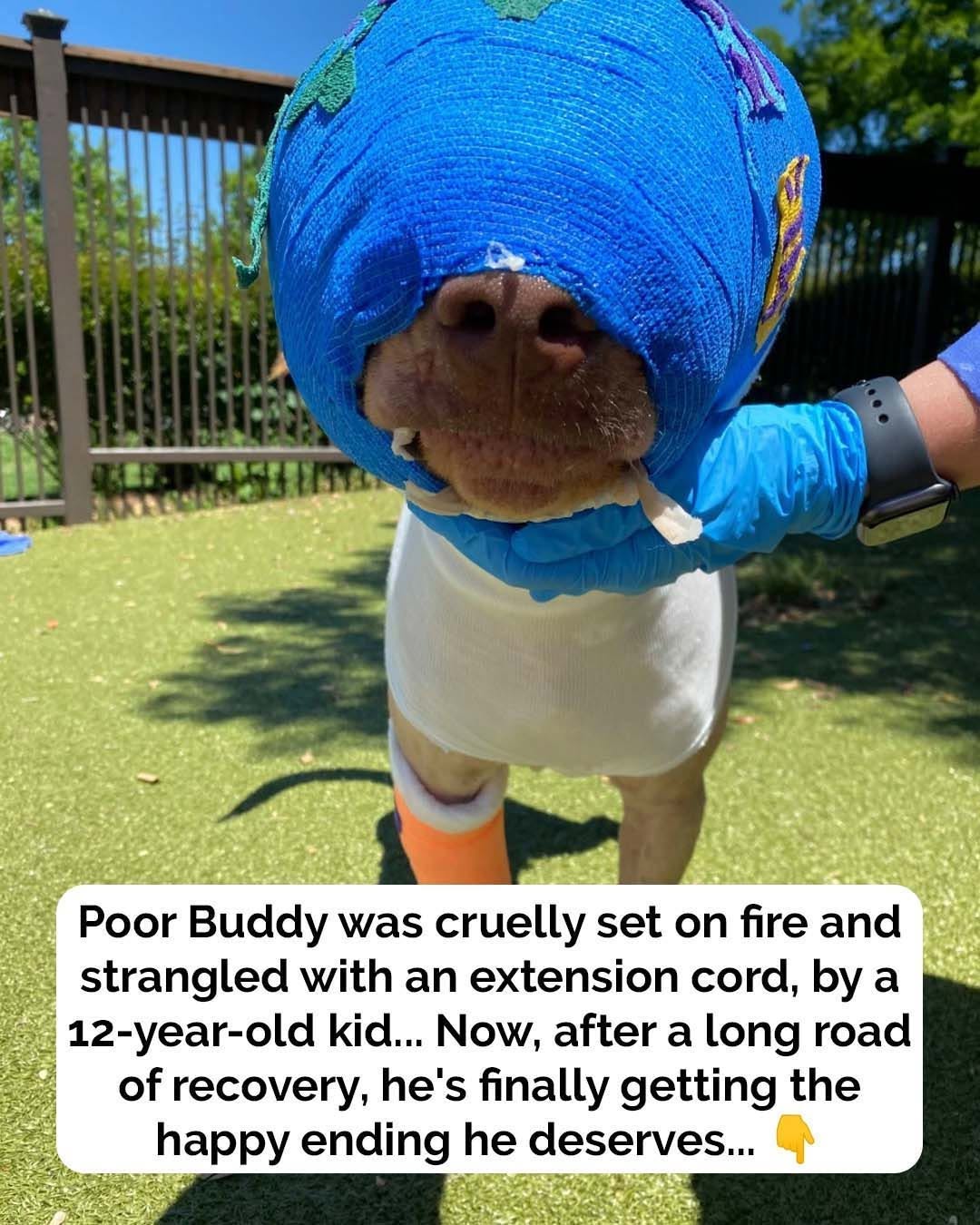
The world went dark for Buddy in a single, agonizing flash of heat and betrayal. He was a carefree, gentle soul—a dog who saw the world as nothing but a playground—until a calculated act of pure, unadulterated evil transformed his life into a nightmare of charred skin and unimaginable agony. Found with a cruel extension cord cinched tightly around his neck and his face scorched into a blackened mask of pain, he was left for dead. Most would have surrendered to the darkness, but Buddy was not just any dog. This is the story of his fight for life.
When the Tunica Humane Society first discovered Buddy in April 2021, the scene was one that would haunt even the most hardened veterans of animal rescue. His face was decimated, his eyes obscured, and his spirit seemingly extinguished by the trauma of being set on fire. The revelation that the perpetrator was a child, too young to face legal prosecution, added a sickening layer of injustice to an already gruesome tragedy. He was transported to the Mississippi State University College of Veterinary Medicine, where he became the focal point of a team of experts tasked with an impossible mission: rebuilding a life that had been systematically torn apart by human cruelty.
Dr. Elizabeth Swanson, an associate professor and veterinary surgeon, described the early days of Buddy’s treatment as climbing a vertical mountain. Every single day was a battle. The medical team had to manage the agonizing reality of severe burn injuries, which meant constant, painful bandage changes, specialized skin grafts, and the persistent, looming threat of infection. Yet, amidst the sterile walls of the hospital and the suffocating weight of his medical equipment, something remarkable happened: Buddy began to show signs of a spirit that refused to be broken. Despite being wrapped in layers of gauze that shielded his body, he maintained a gentle, trusting demeanor that moved everyone who interacted with him.
The journey was agonizingly slow, defined by small, hard-won victories. There were days of doubt, where the severity of his injuries suggested a permanent life of pain, but the veterinary team remained relentless in their care. One of the most significant concerns for the doctors was Buddy’s vision. For weeks, his eyes remained shielded, hidden beneath heavy bandages. The medical team held their breath, hoping against hope that the fire hadn’t stolen his sight along with his comfort. As the weeks turned into months, the progress of the skin grafts began to show. The charred tissue slowly gave way to healing, and Buddy’s personality, once muffled by shock, began to reemerge.
The turning point—a moment that would define the entire narrative of his recovery—occurred on a quiet August day. For the first time since the attack, the medical team removed the bandages from Buddy’s eyes without the need for heavy sedation. The room went silent as he blinked, adjusting to the sudden influx of light. Then, he looked up. In a moment that felt like a divine answer to the thousands of prayers sent his way from across the globe, it was confirmed: Buddy could see. The fire had taken his comfort, but it had not claimed his sight. He was back, and he was ready to reclaim the life that had been stolen from him.

