
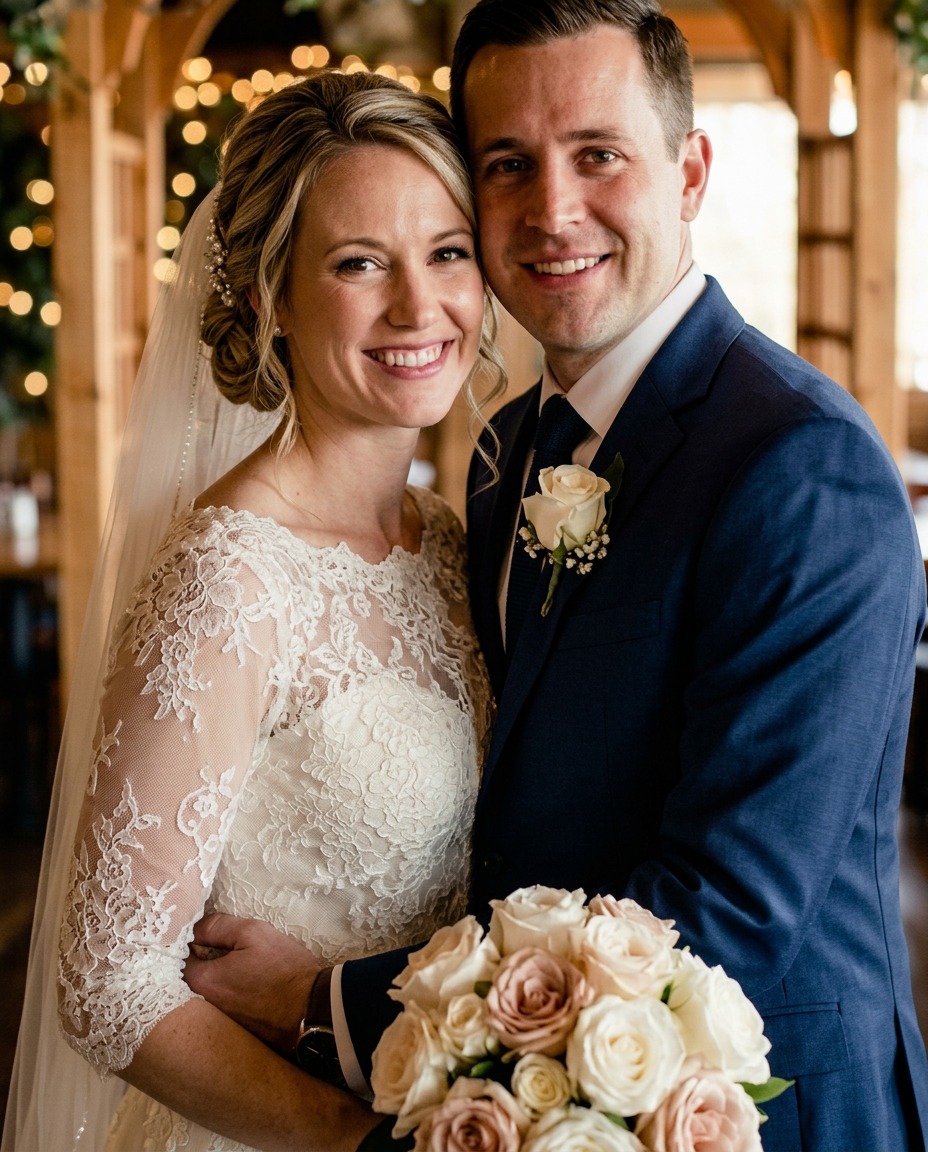
My husband collapsed and died on our wedding day. I arranged his funeral, laid him to rest, and spent a week barely surviving the grief. Then I got on a bus to leave town—and the man I had buried sat down beside me and whispered, “Don’t scream. You need to know the whole truth.”
Karl and I had been together for four years before we married.
I believed I had learned everything that mattered about him in that time. There was only one piece missing: his family.
Any time I brought them up, he shut the conversation down.
“They’re complicated,” he’d say.
“Complicated how?”
He would give a short, humorless laugh. “Rich people complicated.”
And that was always the end of it.
He didn’t stay in contact with them, and he never spoke about them either.
Still, little things slipped through.
One night, we were eating dinner at our small kitchen table when Karl set down his fork and let out a sigh.
“You ever think about how different life could be with more money?”
“Sure. In this economy, even a $50 raise would be amazing.”
He shook his head. “I mean real money. The kind that buys freedom—never checking your balance before shopping, traveling whenever you want, starting a business without wondering if it’ll ruin you.”
I smiled. “You sound like you’re pitching a scam.”
“I’m serious.”
I set my fork down. “Okay, seriously… that sounds nice, but we’re doing okay right now, and as long as I have you, I’m happy.”
He looked at me, and his expression softened. “You’re right. As long as we’re together and don’t have to answer to anyone else, everything will be okay.”
I should have asked more questions, but I assumed he would open up eventually if I just gave him time.
On our wedding day, I believed I was stepping into the rest of my life.
The reception hall was warm, bright, and full of noise. Karl had taken off his jacket and rolled up his sleeves, and he looked happier than I had ever seen him.
He was laughing at something a guest said when his expression suddenly changed.
His hand flew to his chest. His body jerked as if trying to grab onto something that wasn’t there.
Then he collapsed.
The sound of him hitting the floor was awful. For one strange second, no one moved.
Then someone screamed.
The music cut off.
“Call an ambulance!” a woman shouted.
I was already on my knees beside him. My dress spread around me as I grabbed his face with both hands.
“Karl? Karl, look at me.”
His eyes were closed.
I remember people crowding in, then pulling back, then pressing in again.
I remember the paramedics arriving, kneeling over him, saying words like “clear,” and “again,” and “no response.”
Finally, one of them looked up at me and said the words that shattered me.
“It appears to be cardiac arrest.”
They took him away, and I stood in the middle of the dance floor in my wedding dress, staring at the doors long after the stretcher disappeared.
Tears ran down my face.
Someone wrapped a coat around my shoulders, but I barely felt it.
Karl was gone, and a life without him felt impossible.
A doctor later confirmed what the paramedic had suspected. Karl had died of a heart attack.
Four days later, I buried him.
I handled everything because there was no one else to do it.
The only family contact I found in his phone was a cousin named Daniel. He came to the funeral, but no one else from Karl’s family showed up.
He stood off to the side after the service, hands in his coat pockets, looking like someone who wanted to leave but knew it would look wrong.
I walked over to him, grief having burned away any softness in me.
“You’re Karl’s cousin, right?”
He nodded. “Daniel.”
“I thought his parents would come.”
“Yeah…” He rubbed the back of his neck. “They’re complicated people.”
The words made my anger flare. “What does that even mean? Their son is dead.”
He looked at me, then away. “They’re wealthy people. They don’t forgive mistakes like the one Karl made.”
“What mistake?”
Daniel’s phone buzzed. He glanced at it like it had saved him.
“I’m sorry,” he said quickly. “I have to go.”
“Daniel.”
But he was already walking away—fast enough to look like panic.
That was the first crack.
The second came later that night, in the house Karl and I had shared.
Everything looked like he might walk through the door at any moment, and that made it unbearable.
I lay down, closed my eyes, and saw him collapsing again.
And again.
And again.
Before dawn, I got up, packed a backpack, and left.
I didn’t have a plan. I just knew I couldn’t stay in that house another hour. I went to the station and bought a bus ticket to somewhere I had never been, because distance felt like the only thing I could still control.
When the bus pulled away, I leaned my head against the window and watched the city blur into the gray morning. For the first time all week, I could breathe without feeling like I was swallowing glass.
At the next stop, the doors opened. People boarded.
One of them slid into the empty seat beside me, and a familiar scent hit me so strongly it made my stomach twist.
Karl’s cologne.
I turned my head.
It was Karl.
Not someone who resembled him. Not grief playing tricks on me. Karl. Alive, pale, tired—but undeniably real.
Continued on next page:
